Why More Manufacturers Are Switching To Cobot Laser Welding.
Published on 18 November 2025
Across Australia and New Zealand, more manufacturers are looking for ways to improve output, reduce rework, and simplify their welding processes. Cobot laser welding has become one of the fastest growing technologies in this space. It gives production teams the benefits of laser welding without the complexity of a fully enclosed laser cell. As a result, it is becoming a practical step forward for workshops of all sizes, from small fabrication businesses through to large manufacturing operations.
Cobot laser welding combines a collaborative robot with a guided laser weld head. The cobot positions the weld path with high accuracy while the laser delivers fast, clean, low-distortion joints. The operator controls the process through a simple interface, which removes the barrier of advanced robot programming. This combination of accuracy, speed, and accessibility is driving a noticeable shift in how manufacturers approach precision welding.
Faster Adoption and Easier Training
One of the biggest reasons for the rise of cobot laser welding is how quickly operators can learn the system. Traditional robot programming takes time and experience. By comparison, cobot programming is guided, visual, and designed to be picked up rapidly by people with limited welding or robotics background. Training times are shorter and teams can move into production faster. For many manufacturers, this reduces risk when adopting new technology and helps the business realise value earlier.
Cobots also support a flexible workflow. They can be repositioned easily, redeployed for different parts, and adjusted without extensive fixturing or complex programming. This makes the technology highly suited to the high-mix, low-volume nature typical of Australian and New Zealand fabrication. Manufacturers can use cobot laser welding for prototypes, short runs, custom jobs, and repeat production without slowing the workshop. The small footprint also suits facilities with limited floorspace.
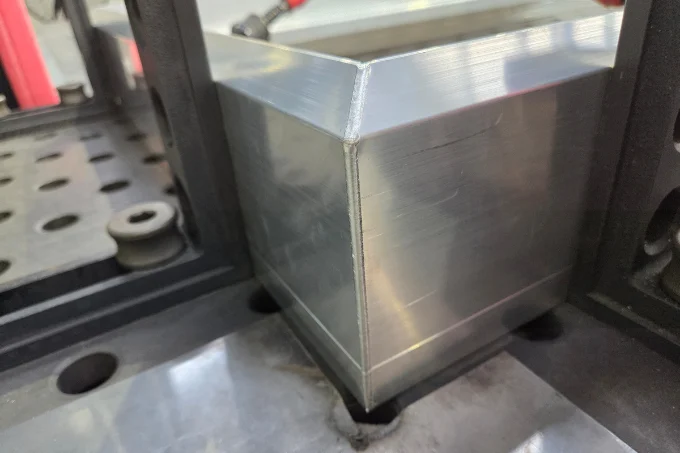
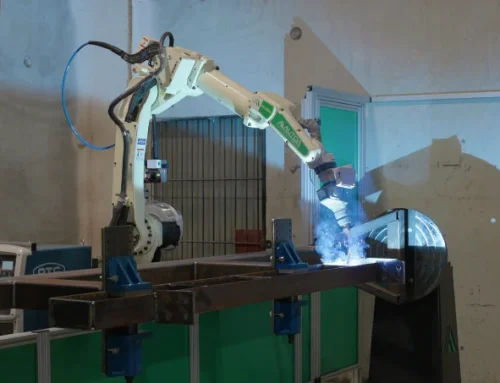
A precise corner weld created with cobot laser welding, delivering a clean and consistent finish.
Cleaner Welds With Less Rework
Speed and weld quality remain major reasons manufacturers seek out laser welding. Cobot laser welding produces consistent, low-distortion seams that significantly reduce post-weld cleanup. Spatter is minimal, joints are clean, and components require far less grinding or rework. For workshops that lose time to finishing or distortion, the difference is immediate.
These advantages become even more noticeable when working with stainless steel, aluminium, or cosmetic components. Laser welding creates fine, controlled seams that stay visually clean. This is valuable for industries where appearance matters, including architectural products, stainless fabrications, enclosures, frames, and precision assemblies.
Reduced heat input also plays a role in weld consistency. Lower distortion protects dimensional accuracy, eliminates many corrective steps, and keeps parts within tolerance. Fewer issues downstream means shorter turnaround times and more predictable production schedules.
Helping Close the Skills Gap
Manufacturers across Australia and New Zealand continue to face a shortage of experienced welders. Cobot laser welding helps bridge this gap by enabling operators with limited welding experience to produce high-quality results. The cobot manages the precision, speed, and repeatability of each weld pass while the operator focuses on setup, inspection, and quality assurance.
This reduces pressure on senior welders and allows them to focus on complex work instead of repetitive production tasks. It also helps companies stabilise output even when labour supply is tight. Many workplaces see a noticeable lift in consistency simply because the cobot removes natural variation that comes from manual welding.
Lower Costs and a Cleaner Working Environment
Cobot laser welding is proving to be cost effective over time. Consumable use is low, cycle times are fast, and reduced rework lowers cost per part. Many teams initially explore laser welding for its cosmetic advantage but adopt it because of the long-term financial benefits. Clean welds, smaller heat-affected zones, and fewer rejected parts create predictable productivity improvements.
Laser welding also supports cleaner and safer workshops. The process produces fewer fumes and less spatter than MIG or TIG, which improves working conditions. Modern cobot laser systems include safety interlocks and enclosure options that support compliance with laser safety standards, making integration smoother for many businesses.
Manufacturers are now using cobot laser welding for sheet metal components, stainless assemblies, brackets, frames, architectural fabrications, and other precision work. Its flexibility, speed, and weld quality make it suitable for a wide range of industries.
Cobot laser welding is maturing quickly and adoption will continue to accelerate across Australia and New Zealand. Increasing demand for consistent quality, reduced rework, and labour flexibility is driving this change. Manufacturers that explore the technology now often find themselves with a stronger production advantage and a more scalable workflow.
If you would like guidance on whether cobot laser welding is a good fit for your components or workflow, Autoa can help you review the process and understand the benefits clearly. Contact Autoa today to see how cobot laser welding can support your production.
hello@autoaweld.com | AU: 1800 573 228 | NZ: 0800 37 55 66
Share this article