The Hidden Cost Of Delaying Robot Welding.
Published on 19 November 2025
Many manufacturers recognise the value of robot welding but hesitate when it comes to investment. The common belief is that the main cost sits in the price of the equipment. In practice, the bigger financial impact comes from waiting too long. Delaying investment creates hidden costs that build across production, labour, and quality, and these costs often exceed the price of a configured robot welding cell.
Across Australia and New Zealand we meet manufacturers who are running strong production schedules but are beginning to feel the pressure of growing demand. Manual processes can deliver excellent results, yet there is only so far a team can push output before capacity becomes a constraint. Once production reaches this point, the financial impact of staying manual becomes more significant.
One of the largest contributors is throughput loss. Manual welding relies heavily on operator speed, experience, and availability. Every job that requires extra care, every delay caused by setup time, and every variation in technique slows the production cycle. A few minutes across many welds adds up to hours. Those hours stack into days. Over the course of a year, this lost time can outweigh the benefits gained from investing in robot welding earlier.
Rework is another area where hidden cost builds quietly. Manual variation often shows up during fit-up, inspection, or final assembly. Even small inconsistencies can shift production schedules and create unplanned labour demands. When a component needs to return to the welding bay, the disruption affects more than the part itself. It impacts delivery dates, downstream processes, and the overall pace of the factory. Robot welding reduces this by repeating the same weld path every time with controlled travel speed and arc stability. The result is predictable quality and fewer interruptions across the day.
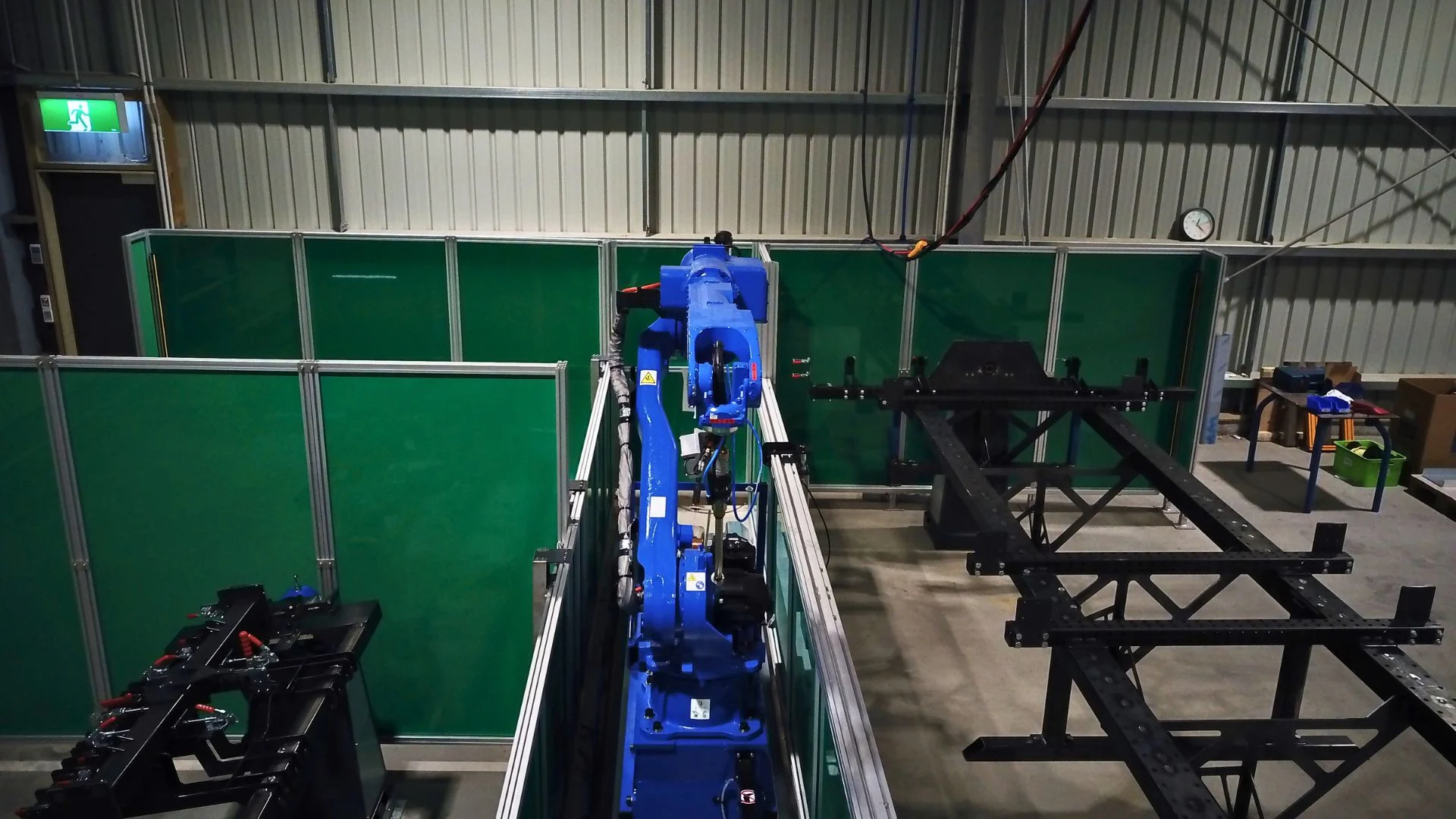
Robot welding cell featuring an industrial robot on a slider.
Labour pressure is a growing factor across the industry. Skilled welders are in demand, and many manufacturers find it difficult to recruit additional staff when workloads increase. Relying solely on manual capacity creates risk when demand changes or when staff take leave. A robot welding cell helps stabilise production by taking on the repetitive, time-consuming welds that absorb much of the team’s attention. This allows skilled welders to focus on high-value work while maintaining consistent output across shifts.
Another cost often overlooked is opportunity cost. When teams spend large portions of their time managing rework, adapting to schedule changes, or trying to keep up with demand, they lose the capacity to take on new work. Growth opportunities are delayed, and competitors who have already invested in robot welding can respond faster. Speed matters, and a configured robot welding cell provides a platform that supports future expansion without adding immediate labour requirements.
The decision to automate becomes clearer once businesses calculate the true financial picture. Lost throughput, manual variation, recruitment challenges, and missed opportunities collectively form a much larger number than most expect. In many cases, the annual cost of maintaining a manual-only welding process is greater than the investment required to introduce robot welding into the workflow.
A configured robot welding cell delivers predictable performance, consistent weld quality, and stable output regardless of operator availability. It helps manufacturers increase capacity without increasing headcount, and it strengthens quality across every batch. For many teams, the productivity gains from robot welding arrive far sooner than anticipated.
hello@autoaweld.com | AU: 1800 573 228 | NZ: 0800 37 55 66
Share this article